
By: Toby Pavon
“Tell me why?”
This has been a common sentiment in the UAAP even before the start of Season 86.
First was the matter of the amateur status of Francis Lopez. The UAAP Board put the matter to rest, deeming Lopez eligible to play in the UAAP, citing technical reasons for the unanimous decision.
“Documents and available evidence to us were reviewed, and it was found by the eligibility committee and approved by the Board of Managing Directors that he was eligible”
Executive Director Atty. Rebo Saguisag
Based on reports and the public statements, it would seem that the board came up with the decision because nobody really questioned his eligibility. It is always good to see a student-athlete be given a chance to compete on their terms, however, it begs the question, what if somebody did question his eligibility?
As far as reports go, Francis Lopez had already signed and accepted payment for a contract with Overtime Elite, an alleged professional league based in Atlanta, Georgia. However, things fell apart when his visa application was denied, with his management group later declaring the contract “void ab initio”, which set the basis for him retaining his amateur status and continuing to be eligible for the UAAP.
None of this was contested, litigated or even discussed at a level of any significance, partially because people didn’t see a problem with him playing in the league, and partially because, such a discussion is impossible. We don’t know where exactly the line between professional and amateur is drawn for the UAAP.
More productive discussions could have been had regarding this if only the UAAP had a rulebook that was made public. There were plans to make one at one point, but it’s unclear if it materialized.
Were a student-athlete to find themselves in a similar situation, and another member team wants to question their eligibility, how would the Board rule, then? Cross the bridge when they get there? That doesn’t sound like sound policy *pun intended*.
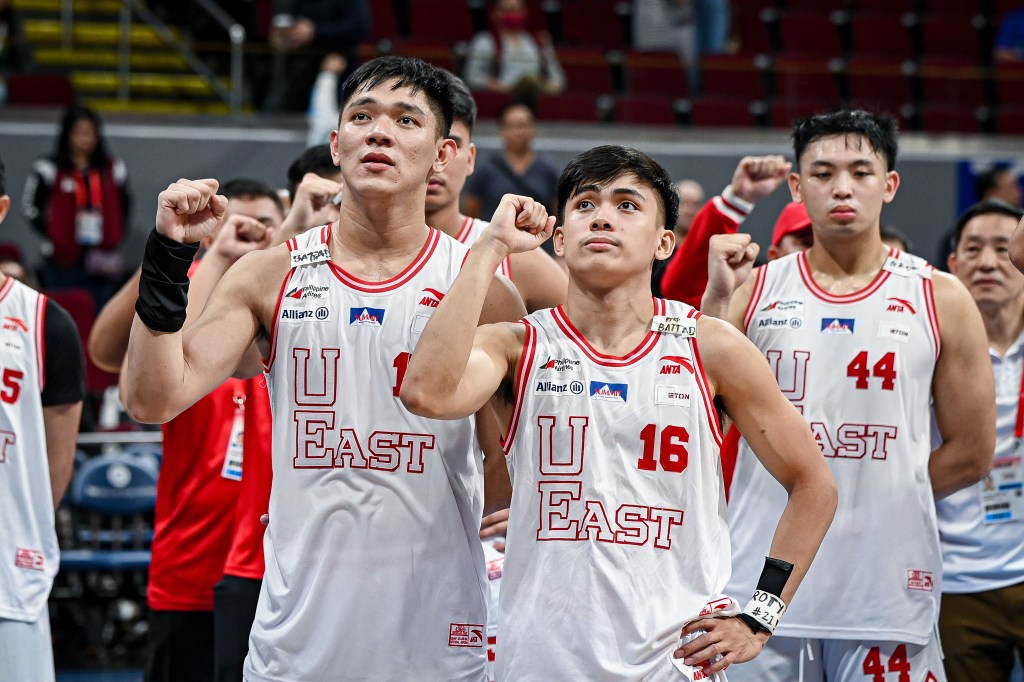
The issue has recently been a matter of debate because of the recent suspension of University of the East’s Precious Endurance Momowei after incurring his second unsportsmanlike foul of the season in their game against De La Salle. Many had already expected the suspension given the two-unsportsmanlike foul rule has long been known to fans. What raised eyebrows was how the outcome was different from that of JD Cagulangan who had incurred a second unsportsmanlike foul in the Finals of Season 85.
Fans had expected Cagulangan to serve his suspension on the opening game of Season 86, however he was there to lead his team to victory. In search of an answer, the clearest is the following:
“I was asked this during opening weekend and finally got an answer from an official source: JD Cagulangan wasn’t suspended in UP’s first game this season following his unsportsmanlike foul in G3 of the S85 Finals because it wasn’t decided/announced by the prior commish in the 48 hour span after the game took place, which is a league rule.”
Naveen Ganglani on Twitter, October 11, 2023
It turns out that the suspension was averted due to a league rule where the suspension should be decided or announced within a 48 hour span from the game where the second unsportsmanlike foul took place, otherwise they won’t impose the penalty.
Okay. We’ll respect that. Rules are rules.
But who knew of this rule?
This is not to comment on the propriety of the rulings of the board, but rather to point out how frustrating the current state of rule-application for the UAAP is. It’s hard for fans and other stakeholders to keep up with decisions without feeling like they’re arbitrary.
It had gotten to a point wherein even a member of the Board had resigned. Although no reason was given for his resignation, the common sentiment is that it’s linked to how the Board ruled on Momowei’s suspension vis-a-vis the alleged infractions of other student-athletes from other member schools.
The UAAP has had a history of having unpredictable rule-application.
When Angelo Kouame was naturalized through an act of congress, there were reports about whether Ateneo could field another FSA that season since “technically” Kouame was already a Filipino. Again, the UAAP Board put the issue to rest by creating a new rule where to be considered a local, a student-athlete must have been naturalized through the administrative process and not through act of Congress.
It wasn’t like Ateneo was planning to recruit another FSA, anyway. They pinkie swore on it.
Okay. We’ll respect that.
But, why the distinction?
The current state of policy-making in the UAAP is undeniably shifty and unpredictable. Sometimes they make decisions that contradict the expectations of the general public and point to a rule that was apparently there… but who could review it? Other times, they simply make up new ones. Are their rulings wrong? This is not what we’re here to discuss. We have to believe that the UAAP Board has the best interest of all its members and stakeholders in mind whenever it comes up with these resolutions and decisions.
The UAAP Board has a tendency apply construction of the rules liberally or strictly on a case-by-case basis, which is not without its merits. Sometimes it rules that its rules apply based on where the previous school of the student-athlete is located, like in the case of Angelo Kouame, other times, it based on whether student-athlete is a foreigner like in the case of Emmanuel Ojuola.
Again, not here to question the propriety of those rulings.
So what’s the problem?
Students, alumni, fans and other stakeholders cannot help but express frustration over not being able to predict how a controversy in the UAAP will be resolved. Yes, there are times where rules have not accounted for particular circumstances which requires deliberation by the board to make decisions that might have to be applied pro hac vice. But for the simpler things, there has to be an effort to be more transparent, which starts with letting the public know what exactly the rules are.
Knowing who can compete and when they can compete is crucial for athletics programs to plan out their player development strategies, and most importantly, not to give their student-athletes false hope that they will be able to compete in the UAAP. For the fans it’s just a general feeling of fairness, knowing that everyone is bound by the same rules.
Without a tangible, transparent way for fans and stakeholders to know what the rules are, there’s no way for them to have a fruitful discussion as to whether or not the rules and the league’s policies are proper, and whether or not they take the league in a direction that people want to go. It’s also the only way that member schools can advocate for their student-athletes effectively.
The UAAP is a league that belongs not to its sponsors, its media partners or even to its Board, but to the students, alumni and administrators of its member schools. It belongs to the fans who enjoy watching dreams come true on the hardwood, so the league and its leadership should be encouraged to let its stakeholders in and let the “see how the sausage is made” so to speak, and help them understand why decisions are being made the way they are. Otherwise, everyone who wasn’t in the room where it happened will be left with speculation forever brewing in their heads, never satisfied with quoted unnamed sources and unofficial releases of the explanations as to “why?”.

 Humblebola
Leave a comment